Trusted by the Fortune 100, early startups, and everyone in between
The shared connection string is a liability you never chose to create. Here's how to make it disappear.
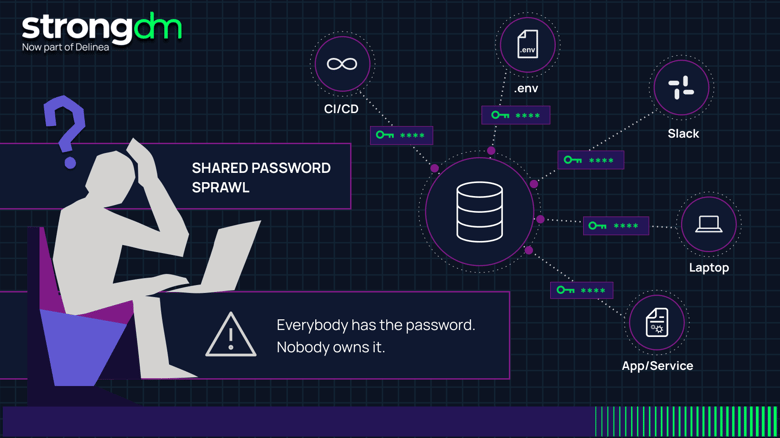
It starts the day you spin up the database. You grab the connection string, password and all, and drop it into a .env so the app boots locally. It goes into CI. A teammate needs it, so it lands in their .env too. A year later it's on six laptops, in two CI systems, and in a Slack message from back when the runbook was still a draft. Nobody planned this. Everybody just needed to connect.
Now try to rotate it.
Nobody decided prod should have a shared password. You have one anyway.
Same story as the SSH keys, one resource over. Nobody scoped a project called "give the whole team a permanent password to production." It accreted: one string, copied wherever it was needed, each copy a reasonable call in the moment. The sum is a single shared credential every service and half the team can read, sitting in plaintext in more places than you can list from memory.
This one is worse, because it's the data itself. An SSH key opens a shell. A database credential opens the rows: customer records, payment history, whatever your business actually runs on. Same possession problem, higher stakes.
And you can't rotate it, because everything hardcodes it. Change the password and you break every .env, every CI job, and every service that memorized it, all at once. So rotation becomes an outage nobody wants to own, and the password from launch day is still the password.
What the shared string actually costs you
Two bills, both quiet until they aren't.
Sprawl. The password lives everywhere it was ever needed and nowhere you can fully account for. Every .env, every CI secret, every pasted-into-Slack copy is a place it can leak from.
No owner. Everyone connects as the same database user, so the database sees one login, not twelve people. When a row changes it shouldn't have, the log says the shared account did it. It can't say which person, which service, or which script.
The Verizon Data Breach Investigations Report analyzes tens of thousands of real breaches each year. Stolen credentials were the initial access vector in 22% of them. Not zero-days. A credential sitting somewhere it could be taken. A shared, never-rotated database password is exactly that credential, and it opens the data directly.
Stolen credentials were the initial access vector in 22% of breaches; 88% of attacks against web applications involved stolen credentials.
So the real question isn't how to manage this password better, or where to store it. It's why it's in anyone's. env in the first place.
Inject the credential at the database. The connection string leaves the laptop.
Flip the model. Instead of copying the password to every place that connects, the credential gets injected into the connection at the database, pulled just in time, only for the life of that session.
The developer authenticates as themselves through your existing identity provider and gets a connection. StrongDM sits between the identity provider and the database: it verifies who you are, checks whether you're allowed, and hands the session the real credential. The .env doesn't hold the password anymore, because it doesn't need to. And this holds wherever your secret lives, whether that's AWS Secrets Manager, Azure Key Vault, GCP Secret Manager, HashiCorp Vault, or elsewhere; the injection happens at the connection, not on the laptop. You're not moving your secrets, you're removing the step where a person ends up holding them.
Because every connection is now tied to a real identity, the audit trail changes completely. Every query is captured and attributed to the human who ran it, not a shared account. When a row changes it shouldn't have, you can see who ran what, against which database, and when. This part is broad: it works across the engines StrongDM connects to, from Postgres and SQL Server to MySQL, Oracle, Redshift, Snowflake, and more.
Then go one level deeper: block the query before it runs
Seeing every query is the floor. On Postgres and SQL Server, you can also decide which queries run at all. Auditing tells you a destructive command happened; policy stops it from happening. StrongDM reads the database protocol and enforces rules at the level of the individual action: allow reads, require a second approver for writes, or block a DROP or an unscoped UPDATE against a production table outright. The command gets stopped at the connection, before it reaches the data, and the attempt is logged against the person who tried it. SQL Server is supported here too.
Be clear about the scope, because specificity is the point. Query-level audit is broad. Per-action policy, the kind that blocks a specific command, is Postgres and SQL Server today. If your sensitive workloads live on Postgres or SQL Server, and for a lot of cloud-native teams they do, that's action-level control exactly where you need it. If they live somewhere else, you still get identity-tied access and full query audit, you just don't get action-level blocking on that engine. That's a sharper story than a vague "works on your databases."
The same holds for the things that aren't people. A batch job, a data pipeline, an AI agent reaching into the database: each usually holds a standing credential in a config file, which is the shared-password problem wearing a different hat. The same path covers it. The non-human identity gets its credential injected at connect, the same policy decides what it can run, and every query it makes is attributed and audited. A service account that only needs to read doesn't get to DROP a table, whether it's a cron job or a model.
What you get back
You never set out to run a shared-password program for production. The connection string comes out of every .env and every CI secret. Rotation stops being an outage. Offboarding becomes turning off one identity, once. And you finally get the two things the shared password could never give you: every query tied to a real person or service, and on Postgres and SQL Server, the ability to stop the destructive one before it lands.
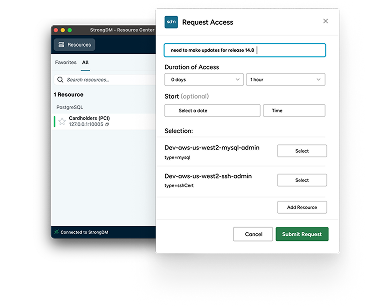
Want to see it? The demo below shows access to a production database with no credential exposure, plus two controls the policy enforces: MFA on connecting to production, and a required human approval before anyone can act on sensitive data.
Next Steps
StrongDM unifies access management across databases, servers, clusters, and more—for IT, security, and DevOps teams.
John Martinez, Technical Evangelist, has had a long 30+ year career in systems engineering and architecture, but has spent the last 13+ years working on the Cloud, and specifically, Cloud Security. He's currently the Technical Evangelist at StrongDM, taking the message of Zero Trust Privileged Access Management (PAM) to the world. As a practitioner, he architected and created cloud automation, DevOps, and security and compliance solutions at Netflix and Adobe. He worked closely with customers at Evident.io, where he was telling the world about how cloud security should be done at conferences, meetups and customer sessions. Before coming to StrongDM, he lead an innovations and solutions team at Palo Alto Networks, working across many of the company's security products.
💙 this post?
Then get all that StrongDM goodness, right in your inbox.
As AI agents take on actions once performed only by humans, traditional identity systems can’t provide clear delegation or accountability. StrongDM ID gives every agent a unique, verifiable identity linked to a human sponsor, ensuring organizations always know who authorized every action. In the next era of identity, authentication matters—but delegation defines trust.
As AI agents take on actions once performed only by humans, traditional identity systems can’t provide clear delegation or accountability. StrongDM ID gives every agent a unique, verifiable identity linked to a human sponsor, ensuring organizations always know who authorized every action. In the next era of identity, authentication matters—but delegation defines trust.
The modern cloud is fast, dynamic, and complex. But legacy security tools can’t keep up. As containers and ephemeral resources constantly change, and access requests surge, security teams are left scrambling. Entitlements pile up, visibility fades, and audits become a nightmare.
The modern cloud is fast, dynamic, and complex. But legacy security tools can’t keep up. As containers and ephemeral resources constantly change, and access requests surge, security teams are left scrambling. Entitlements pile up, visibility fades, and audits become a nightmare.
StrongDM debuts in Gartner’s Magic Quadrant for PAM, redefining privileged access with real-time, policy-based authorization for modern cloud environments.